


Welcome to Speaker Fuzz

By k_sonic • Technical Editor
Welcome to Speaker Fuzz, a chronicle of the sounds that shaped rock and roll. Inspired by blues, rock, and all forms of sonic mayhem, we discuss our namesake and the birth of noise.
I. Slashed Speakers: Early Attempts at Noise
Early guitar amps were designed to be clean and pristine; however, experimentation and happy accidents of tone chasing allowed guitarists to push their amplifiers towards a sound they weren’t built to make. Before the invention of the “fuzz pedal,” a torn, buzzing snarl was achieved by pushing a tube amp past its limits—or damaging it outright.
The most infamous case belongs to Dave Davies of The Kinks. Frustrated with an overly clean tone, he took a razor blade to his amp’s speaker cone, slashing it repeatedly. The result was a ragged, spitting distortion that became the riff on “You Really Got Me” in 1964. Fuzz didn’t arrive as an invention—it arrived as sonic destruction that someone decided to keep. The raw and beautiful sound of an amp sounding like it’s exploding was born.
“Fuzz didn’t arrive as an invention—it arrived as sonic destruction that someone decided to keep.”
— K_SONIC
II. Satisfaction and Haze
A happy accident again, the Maestro FZ-1 Fuzz-Tone was invented out of inspiration for a studio recording mishap that created an accidental buzzing bass sound. The pedal was built for Gibson to replicate this distorted texture. In 1965, Keith Richards ran his guitar through the Maestro Fuzz-Tone intending to imitate a horn section—to sketch a placeholder riff for “(I Can’t Get No) Satisfaction.” The Fuzz-Tone’s buzzing, saturated tone was supposed to be temporary. It became one of the most recognizable guitar sounds ever recorded, and it made fuzz a commercial product overnight.
Jimi Hendrix took that same idea and built his sonic blueprint out of it, using a Dallas Arbiter Fuzz Face and Roger Mayer Octavia to blast his Fender Stratocaster into a wall of Marshall amplifiers. Songs such as “Foxy Lady” and “Purple Haze” signaled that fuzz was in full force and rock was now meant to be played loud. Hendrix would inspire countless other legends, including Stevie Ray Vaughan, Eric Clapton, Robin Trower, and Eddie Van Halen, to name a few.
III. Progressive Rock and the Alternative Era
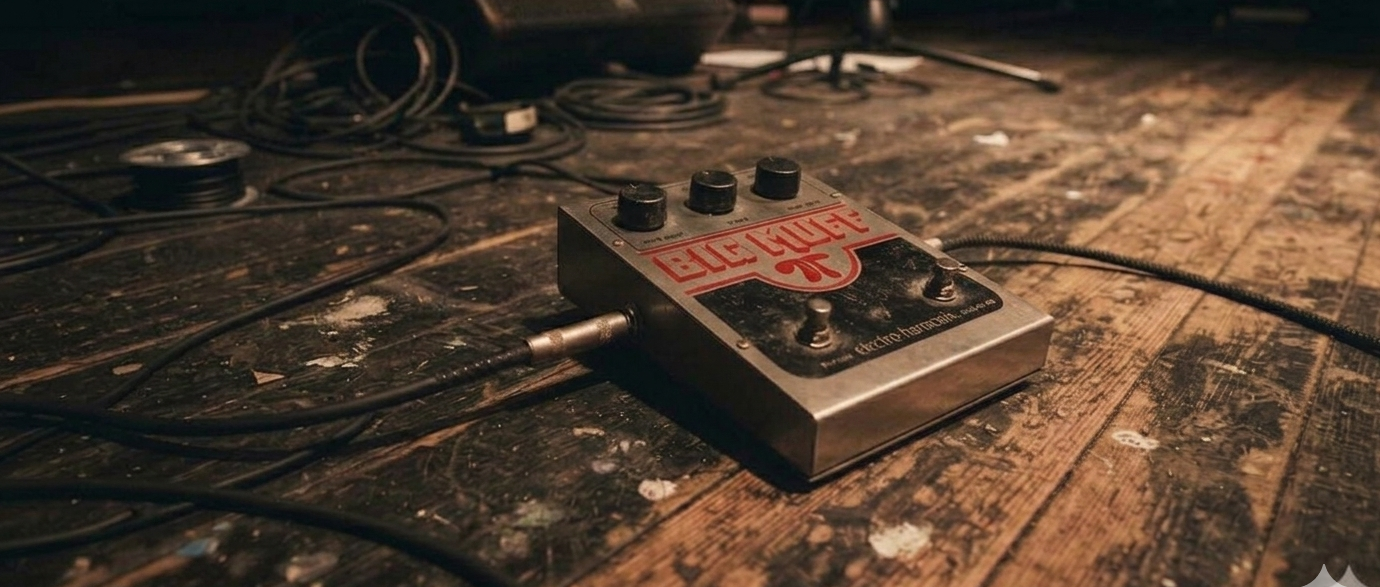
Pink Floyd’s David Gilmour used fuzz for texture rather than aggression, running his pedals, with a mainstay being the Big Muff, into Hiwatt amplifiers to give the band’s psychedelic passages a cutting edge without losing their spaciousness—fuzz paired with delay for massive sonic texture. The solos in “Comfortably Numb” still haunt us at Speaker Fuzz to this day. His solo work continues to feature this setup, with his newest album “Luck and Strange” being one of his catalog’s highlights.
The 90s brought forth a new era of guitarists blasting their amps with fuzz. Smashing Pumpkins’ Billy Corgan reached for the Big Muff, chasing the thick, doom-heavy low end of Black Sabbath on records like “Siamese Dream.” What began as a slashed fuzzy speaker cone had become a deliberate, studied pursuit of heaviness. Dinosaur Jr's J Mascis did much the same, with a country tinge added to his stacks of Marshalls. The Big Muff became so vital to his sound that he collected as many vintage pedals as he could get his hands on. Last but not least, Mogwai, taking their name from the movie Gremlins, would drop the vocals and take fuzzy space rock instrumentals to the highest of heights. A fun fact: Electro-Harmonix has issued versions of the Big Muff for each of these bands, with Mogwai being the most rare.
Bringing things full circle, Electro-Harmonix has also released the Ripped Speaker Fuzz Pedal, paying homage to those early days of intentional speaker destruction in the name of fuzz.
Back to Articles